Quiet Side Street or Main Road: Two Route Choices, Two Kinds of Attention
Quiet side street or main road: compare traffic, junctions and wayfinding to choose a cycle route that suits the conditions and your attention.
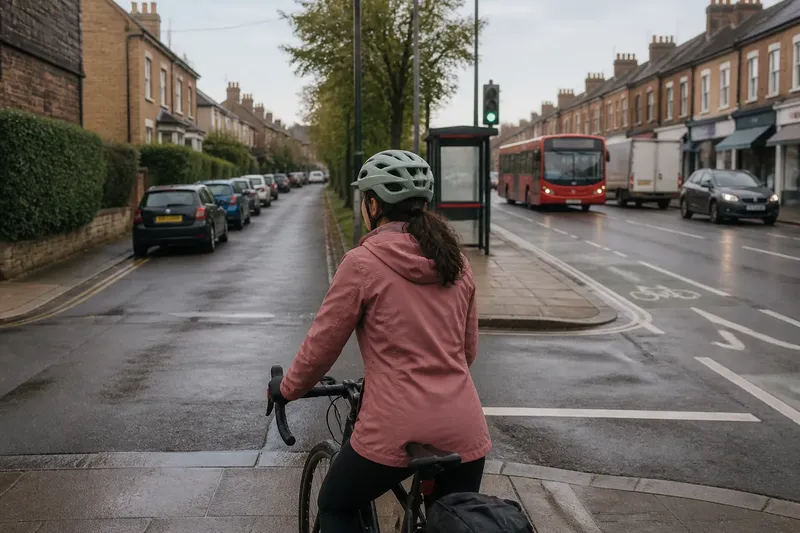
At the end of a row of shops on a damp weekday morning, a rider can turn into a quiet side street or continue beside the bus stop. Choosing a quiet side street or main road means weighing the traffic around you against the way each street is used.
Side streets bring their own kinds of traffic
Fewer vehicles may pass along a side street, but its traffic can be less continuous. A car might emerge from a driveway, reverse out of a parking space or approach from a junction partly hidden by a hedge. Parked vehicles can also make it harder to see people crossing between them.
That stop-and-start pattern affects what you need to watch. On a calm stretch, a rider may have time to hear a car approaching from behind; near a row of driveways, attention may shift to vehicles appearing at the kerb. A quiet street can feel calm without being predictable.
People use residential streets for more than driving through. Someone may open a car door, carry shopping across the road or wheel a bin to the kerb. These ordinary activities are part of the street’s traffic, too.
Main roads concentrate movement and activity
A main road often carries several kinds of traffic at once: buses pulling in, cars turning into side roads, delivery vehicles stopping near shops and pedestrians crossing between destinations. The regular flow can make the direction of travel clear, but each change in movement asks for attention.
Look at how traffic interacts with the space you would ride in. A painted cycle lane may pass a bus stop, loading bay or parking area. Near a junction, a vehicle may turn across a cyclist’s path. A broad carriageway does not by itself tell you how the traffic will behave.
Some riders prefer the visible, steady flow of a main road to the interruptions of a residential street. Others find the noise and volume tiring. Neither preference is a measure of skill; what matters is whether the conditions let you make decisions without feeling pressed.
Compare the traffic patterns on each route
Think of each route as a different room: one has a steady hum of conversation, while the other is quiet until someone opens a door. The sound differs, but so does the timing of what needs your attention. Compare actual street activity rather than relying on labels such as “quiet” or “main”.
- Vehicles passing: If traffic flows steadily and you feel crowded by it, consider a parallel street; if the side street has frequent sudden approaches, consider a road with more visible movement.
- Turning traffic: If vehicles often turn across your path, look for another route or a crossing point where you can wait and reassess; if turning movement is occasional and easy to observe, continue only when the path is clear.
- Stopping and loading: If buses or delivery vehicles regularly stop in the space you would use, seek an alternative stretch; if activity is occasional, watch for it and be ready to pause rather than squeeze past.
- Parked cars and doors: If a row of parked cars blocks your view or leaves little room, choose a street with clearer space where possible; if gaps are visible, keep an eye on doors and people near the vehicles.
- Driveways and entrances: If many entrances have obstructed views, favour a route with fewer hidden approaches; if an entrance is in clear view, stay alert for vehicles pulling out.
- People crossing: If shops or homes bring people into the road unexpectedly, slow down or choose a less busy stretch; if the pavement is active but crossings are visible, leave room for people to move.
- Your comfort with the traffic: If the activity makes it hard to stay composed, pause or take a calmer alternative; if you can observe it without feeling hurried, continue while reassessing conditions.
These checks are not a scoring system. One awkward stretch can shape the whole choice. Traffic also changes during school runs, deliveries, roadworks and local events, so a route that usually suits you may call for a different decision today.
A worked journey shows how traffic can change the choice
Say Maya is cycling from a library to a community centre. Her usual route follows a main road with a bus stop near a junction. On this particular morning, a delivery vehicle is stopped close to that junction. She can see that turning traffic is moving across her path, and the vehicle makes the view less clear.
Maya considers a parallel side street. She already knows that it has parked cars and several driveways. Her starting information is therefore specific: the main road has a temporary obstruction beside turning traffic; the alternative has less through traffic but repeated entrances and parked vehicles.
She chooses the side street, rides at a pace that lets her watch for cars emerging from driveways and checks each junction before proceeding. The expected observable result is that she avoids the blocked main-road section while remaining alert to the side street’s hidden approaches. The trade-off is more frequent checks, not a promise of a faster or easier ride.
If Maya instead found that parked cars hid the side street’s entrances, she could reject that option and wait for a clear opportunity on the main road, or pause to consider another route. The choice follows the conditions she can see, not a fixed rule that one type of street is always preferable.
Questions about side streets and main roads?
Is a quiet side street always better for cycling?
No. It may have fewer passing vehicles but more hidden driveways, parked cars or people stepping into the road. Consider how traffic appears and moves, not just how much of it there is.
What makes main-road traffic harder to deal with?
Buses, turning vehicles, deliveries and people crossing can all create competing movements. Notice where they meet the space you would ride in and choose another stretch if you cannot comfortably respond.
How can I check traffic before a ride?
Look at a route map for main roads, side streets and junctions, then pay attention to local signs about closures or roadworks. For an unfamiliar stretch, a visit on foot can help you see where vehicles stop or cross, though conditions may differ when you ride.
Should I change routes when traffic conditions change?
Yes, if a temporary obstruction or unusual flow makes the route difficult to read. You can pause, wait for a clear opportunity or choose another street; you do not have to continue just because it is your usual route.
Choose by the movement you can respond to
A side street may have fewer passing vehicles but more sudden arrivals from driveways. A main road may have a clear flow but more turning, stopping and crossing activity. Quiet side street or main road is best answered by looking at the traffic pattern on the particular stretch you need today.
On your next ride, pay attention to where vehicles stop, turn and emerge rather than judging the whole route by its name. That gives you a more useful basis for deciding whether to continue, pause or take another street.