A First Ride to a New Destination: Make a Plan You Can Adjust
Plan a first bike ride to a new destination with a clear meeting point, a sensible arrival plan and simple options if the final approach feels awkward.
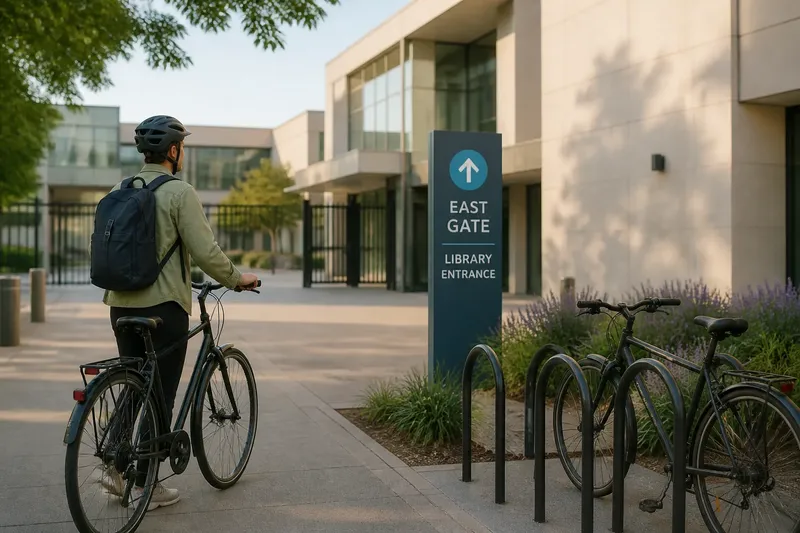
You reach the community hall and find three entrances, none of them facing the street named in the address. A first bike ride to a new destination is easier when you plan not only how to get there, but also where you will leave your bicycle and how you will recognise the right entrance.
The aim is not to account for every turn. It is to make the arrival feel manageable: agree on a precise meeting point, check access details and leave room to adapt if the place looks different on the day.
Plan the arrival, not just the journey
Before setting off, consider what you will be carrying, whether you expect to arrive in daylight and how much time you have to settle in. A venue inside a campus, market or housing development may have several gates. A café on a busy street may be easy to spot but awkward to stop beside.
Think of your arrival plan like a coat hook by the door: it gives your visit a place to land. Knowing where you can secure your bicycle and which entrance to use can matter more than memorising the names of streets along the way.
- Check the venue’s full address. If the address identifies a single street entrance, use it as your starting point; if it covers a large site, look for a named gate or building entrance and use that instead.
- Check the entrance location. If the venue’s directions show a clear public entrance, note its name; if not, contact the venue or agree to meet outside a recognisable nearby place.
- Check bicycle parking. If there is suitable cycle parking near your entrance, plan to use it; if not, ask the venue about an appropriate option rather than leaving your bicycle where it blocks access.
- Check the meeting point. If both people can identify the same gate, corner or public entrance, share that exact point; if “by the park” could mean several places, choose a more precise alternative.
- Check the expected conditions. If the final approach may be busy, dark or affected by temporary works, allow time to pause and reconsider; if it looks straightforward, keep the plan simple.
- Check what to do if plans change. If you can contact your companion or the venue, keep those details handy; if you cannot, agree on a clear waiting place before leaving.
Each check should lead to a practical choice. You do not need to build an elaborate plan for every visit, but resolving the uncertain parts in advance can prevent a hurried decision at the entrance.
Choose a meeting point both people can find
For a first visit, “near the station” or “outside the market” can leave too much room for interpretation. Pick a particular public entrance, named gate or corner. Send the location to the person you are meeting, along with a simple fallback such as waiting beside the main entrance if you arrive separately.
Consider whether the meeting point is suitable for a person arriving with a bicycle. A narrow pavement or doorway may leave little room to wait without obstructing others. If there is no comfortable place to stop, choose a nearby public spot where you can get off the bicycle and stand clear of the flow of people.
Check access and bicycle parking before the day
A map pin may mark the centre of a building rather than its public entrance. Check the venue’s own directions, any access notes and the location of cycle parking. If the building is part of a larger site, find out whether you need to enter through a particular gate or walk your bicycle through a pedestrian area.
Notice any instructions that affect access, and follow local signs and rules. If the venue’s information is unclear, contact its staff rather than guessing which entrance or parking area is intended.
Allow time to settle in
A first visit can involve locking your bicycle, checking that you have the right entrance and putting away a helmet or rain layer. Leave enough time for those small tasks instead of aiming to arrive just as the meeting begins. If your appointment has a fixed time, confirm the venue’s opening and access information before setting off.
Imagine you are meeting a friend at a library inside a large civic complex. The hypothetical starting details are that the address names the complex, the map pin sits near its centre, and the library’s directions identify a public gate on the east side. You check the directions, choose that gate as the meeting point, and see that the cycle parking is beside it. You send your friend the gate name and agree to wait there if either of you arrives first. The resulting plan gives you a specific entrance and parking place; the trade-off is that you must follow the library’s access directions rather than rely on the general address alone.
What should I check before setting off?
Should I plan every turn?
For this kind of first visit, focus on the destination’s entrance, bicycle parking and meeting point. If you also need directions for the ride itself, plan only the decisions you cannot comfortably leave until later.
What if the entrance is unclear?
Check the venue’s own directions or contact its staff for the public entrance. If you still cannot confirm it, agree to meet at a nearby, clearly named public place and contact your companion when you arrive.
Where should I leave my bicycle?
Use cycle parking identified by the venue or a suitable public rack, following any local signs. If you cannot identify an appropriate place, ask the venue rather than blocking a doorway, pavement or access route.
What if my companion is not there?
Wait at the agreed spot if it is comfortable and does not obstruct anyone, then use your agreed way to contact them. If the spot becomes crowded or unsuitable, move to the fallback place you discussed before the ride.
Check the return before heading home
Before leaving, make sure you know where your bicycle is and that it can be retrieved without entering a restricted area. If the venue has changed its access arrangements or the space around the entrance has become busy, choose a clear place to collect your belongings and move away.
The return may feel different if the light or weather has changed, or if you are carrying something you did not have on the outward trip. Take a moment to consider whether your original plan still suits you. For a first bike ride to a new destination, a clear meeting point, a known entrance and an appropriate place to leave your bicycle make the arrival easier to manage without turning the visit into a rigid schedule.